


Tesla FSD speed offset function breaches UN and EU rules, says ETSC ahead of discussions on EU-wide approval
ETSC is calling on the European Commission and EU Member States to reject two speed-related functions in Tesla’s FSD (Supervised) driving assistance system, ahead of key discussions at the EU’s Technical Committee on Motor Vehicles (TCMV) on 6 October.
In a new briefing published today, ETSC finds that one of the functions, “speed offset,” is not merely undesirable on safety grounds but is prohibited outright by the UN regulation that governs driver assistance systems in the EU. The second function, “contextual max speed,” is promising, but currently allows the vehicle to set its own speed ceiling based on the speed of surrounding traffic – meaning a car surrounded by drivers who are breaking the speed limit could use that as grounds to break it too.
“These are not minor technicalities,” said Frank Mütze, automation specialist at ETSC. “ ‘Speed offset’ breaks an existing rule that the EU agreed at UN level. ‘Contextual max speed’ allows the car to treat other people’s law-breaking as a justification for its own. If the EU approves either as they stand, it will hand every manufacturer a template for ignoring speed limits in future vehicles.”
Background
On 10 April 2026, the Dutch approval authority RDW granted Tesla’s FSD (Supervised) a provisional national type approval under the EU’s “Article 39” exemption procedure, which allows new technologies that don’t fit existing rules to be approved. That approval only becomes EU-wide if the European Commission authorises it – which requires a positive vote from Member State representatives sitting on the TCMV committee. That vote has not yet been scheduled but further discussions will be held when the committee meets on 6 October.
In the meantime, several EU Member States: Belgium, Czechia, Denmark, Estonia, Lithuania and Slovenia have recognised the Dutch approval, enabling the system to be used in these additional countries.
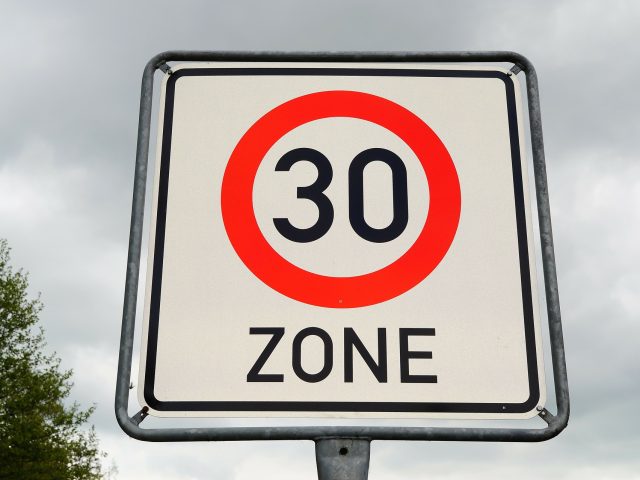
A report published last week by the Belgian organisation johanna.be found that, during its testing of the system, Tesla FSD repeatedly recognised but then ignored 30 km/h zone speed limit signs and made repeated attempts to overtake cyclists on designated cycle streets, which is against the law in Belgium. ETSC’s findings are not directly linked because neither speed offset nor contextual max speed were used during the tests by the Belgian researchers.
ETSC’s findings on speed, published today are summarised below:
Issue 1: The speed offset breaches UN Regulation No. 171
Tesla’s owner’s manual explains how drivers using the FSD system can switch on a permanent speed offset of up to 50% above every detected speed limit – turning a 50 km/h limit into a ceiling of 75 km/h, or a 30 km/h zone into 45 km/h.
ETSC’s briefing sets out, element by element, why this satisfies the exact prohibition in UN Regulation No. 171 (the “DCAS” Regulation), which applies on a mandatory basis in the EU:
“The system shall not enable the driver to set a default offset by which the current maximum speed is supposed to exceed the system-determined road speed limit.”
Tesla did not list speed offset among the functions covered by Article 39 exemptions – implying it was assessed as compliant with existing rules. ETSC argues it is not, and that it should not have been approved.
Safety risks rise sharply with speed: the probability of a pedestrian being killed in a collision with a passenger car going at 50 km/h is more than five times higher than at 30 km/h.
Issue 2: Contextual max speed risks copying other drivers’ law-breaking
The second function, “contextual max speed,” lets the system revise its speed ceiling using cues from the driving environment – including the speed of other traffic.
ETSC supports using contextual information on the type of road such as road markings, layout and infrastructure to determine speed limits more accurately. But it warns that speeding is widespread on European roads, so the speed of other traffic is not reliable evidence of what the limit actually is. A system that raises its own speed ceiling because other cars are speeding does not appropriately correct for uncertainty – it helps perpetuate law breaking.
ETSC’s recommendations
To the European Commission and Member States, ahead of the 6 October meeting:
- Reject approval of the “speed offset” function, which is prohibited under Paragraph 5.3.7.4.9 of UN Regulation No. 171 and was reportedly not covered by Tesla’s Article 39 exemption.
- Reject the approval of any “contextual max speed” function that uses the speed of other traffic to set the current maximum speed or determine the applicable speed limit.
- Do not put the FSD approval to a vote at all until a public discussion has concluded on whether the underlying rules should be expanded to permit hands-off driving and system-initiated manoeuvres outside motorways.
-ends
Notes to editors
- ETSC’s full briefing can be downloaded from the ETSC website
- ETSC has separately called for the FSD (Supervised) approval not to be put to a vote until a wider public debate concludes: Letter: Ensuring transparent and inclusive EU policy-making for assisted driving systems
- ETSC’s broader concerns about the provisional approval are set out here: Tesla approval pushes Europe towards a road safety cliff-edge
- UN Regulation No. 171 (“DCAS”) is available here.
- Excessive and inappropriate speed contributes to around a third of fatal road collisions in Europe and aggravates the severity of most others. See ETSC’s report Reducing speeding in Europe.
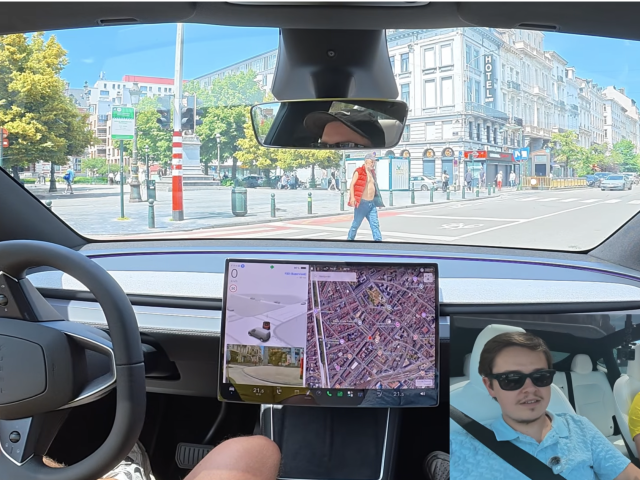
Photo: Tesla FSD operating in Brussels, Belgium / YouTube – Zelfrijder