France study visit on Speed Management and Automated Enforcement 2026

A study visit on speed management and automated enforcement was held in France on 12–13 October 2026 as part of the EU-funded EU Road Safety Exchange project, with activities taking place in Paris and Rennes.
Hosted by the Delegation for Road Safety of the French Ministry of Interior and the National Processing Centre (CNT) in Rennes, the visit brought together participants from five countries, including representatives from the Austrian Ministry of the Interior, Belgium’s FPS Mobility and Transport, the Slovenian Traffic Safety Agency and Slovenian Police, the Hungarian Police and the State Police of Latvia.
The first day opened at France’s Delegation for Road Safety in Paris, where Interministerial Delegate Estelle Balit welcomed participants and presented France’s approach to road safety. Working with ministries, law enforcement and local authorities, the Delegation deals with measures ranging from education and prevention to automated enforcement.
She outlined France’s ongoing challenges, including the expansion of average-speed controls alongside its network of around 4,600 speed cameras. Despite decades of progress, road deaths remain a concern. Drug driving was also discussed, with France exploring an effects-based approach to enforcement that could cover substances according to their impact on driving. Estelle Balit stressed that a clear legal framework and transparent enforcement are crucial to maintaining public trust and encouraging compliance.


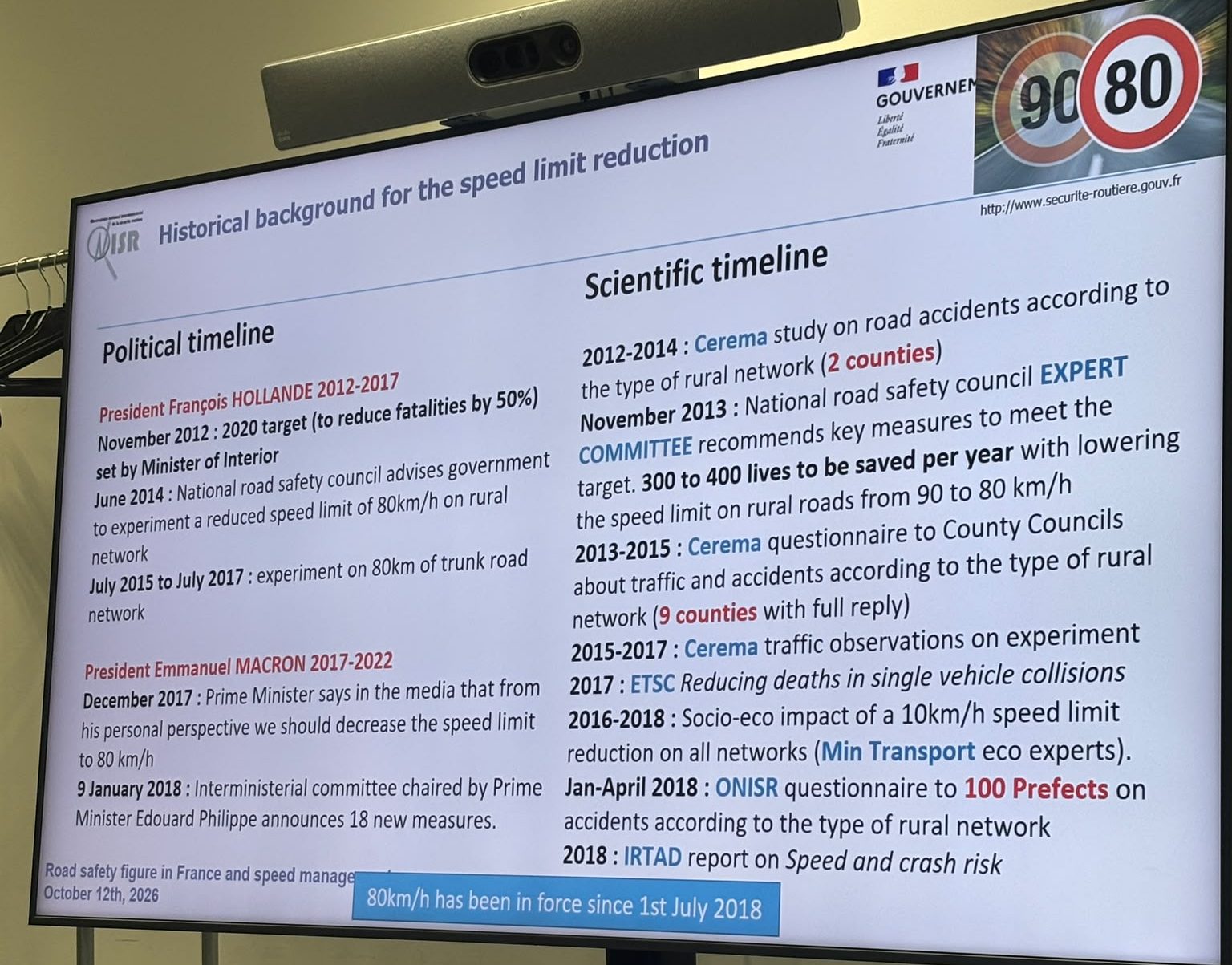
Manuelle Salathé, Secretary-General of France’s National Interministerial Road Safety Observatory (ONISR), presented in-depth road safety data from France and an overview of their speed management system. She talked about speed as the main risk factor for fatal crashes outside urban areas and the life-saving potential of reducing speeds.
She stressed that around 60% of road deaths in France occur on rural roads and explained the country’s decision to lower the speed limit on these roads from 90 to 80 km/h, the safety concerns on major rural routes that led to the change, and the challenges that followed. She also discussed current road safety trends for PTWs and how modern radar technology has improved the detection of speeding by powered two wheelers (PTW) and heavy goods vehicles.
Guillaume Girod-Vitouchkina, Head of the Department of Automated Control, explained how France plans its automated enforcement network, including how crash rates inform camera placement. He compared the fixed, movable and mobile cameras in use, explaining how decisions also take account of installation and maintenance costs, as well as the cost per offence detected.
He discussed plans to introduce speed cameras in cities, giving local authorities a greater role in enforcement and the challenges of adapting a system built around centralised processing as enforcement expands to the local level. Planned enforcement measures for vehicle noise and weight were outlined, as well as the change of legislation allowing insurance checks in cases of excessive speeding.


Renald Clément explained the legal framework behind automated enforcement and why a clear legal basis is essential to the system’s effective operation. He also described its territorial set-up, with the prosecutor’s office in Rennes having national jurisdiction over automated enforcement cases. French law aligns the offences that can be detected by radar with those for which the registered vehicle owner is financially liable, so the notice goes to the owner, who can pay the fine or identify the driver.
Participants discussed attempts to evade fines, including “ghost garages” and cases where close family members are named as drivers, and plans to tackle these issues. Representatives from the participating countries shared some of the issues they are confronted with when enforcing automated speed controls.
.




On the second day, participants travelled to Rennes to visit the National Centre for Processing of Traffic Fines (CNT). Operated by ANTAI (the National Agency for the Automated Processing of Offences), the centre coordinates the end-to-end processing of traffic violations detected across France, playing a key role in the country’s automated enforcement system.
Catherine Védrenne, Secretary General of ANTAI, opened the programme with an overview of the centre’s organisation, key figures and the procedures for processing fines issued for offences detected by automated cameras. She also highlighted the growing use of digital services, with an increasing number of notices now being sent by email, helping to modernise communication with road users and streamline the notification process.

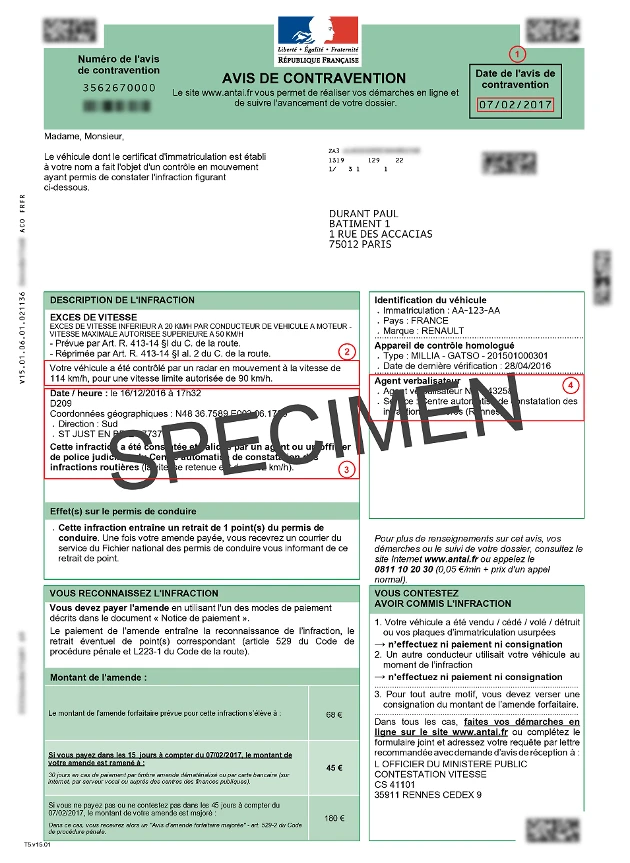
Participants then followed the same process that a fine follows through the CNT. At Docaposte, they saw how camera images are checked, licence plate details are entered into the system and notices are prepared for mailing. At the Automated Centre for the Observation of Traffic Offences (CACIR), participants heard about its structure and the division of responsibilities between the police and the gendarmerie. Colleagues demonstrated different cameras, showing how they detect speeding and red-light offences and how those offences are checked.
The programme continued with visits to the Public Prosecutor’s Office at the CNT and the call centre. Participants saw how the different parts of the system work together, from camera detection and verification to sending notices and handling appeals.
The study visit gave participants a detailed look at France’s approach, from decisions about safety camera locations and types to the legal framework and the processing of fines. It also showed how clear rules, coordination between stakeholders and communication with drivers support a large-scale automated enforcement system.
EU Road Safety Exchange creates a network of road safety professionals committed to sharing good practice and making safer roads across the EU.